
To get access to the PAW platform or create an account or access please contact rc@petfoodcompliance.com.
Layers of Licensing: Which Entities Register What & Why The Answer Isn’t Straightforward

Ask five (non-compliance) people in the pet food industry which company is responsible for registering a product, and you'll probably get five different answers. Some will tell you the manufacturer handles it, others swear it's whoever's name sits on the label. A few will mention co-packers, and at least one person will just shrug and say "it depends on the state."
And the frustrating reality is they're all a little bit right. Pet food licensing comes down to fifty sets of rules, with each state deciding for itself which entities in your supply chain need to show up on paperwork. Understanding the roles involved, and where each one typically fits into the licensing picture, is the fastest way to stop getting tripped up by conflicting advice.
The Three Layers, In Short
Before getting into who registers what, it helps to remember the three layers doing the deciding:
- The FDA, which regulates pet food at the federal level under the Federal Food, Drug, and Cosmetic Act and oversees facility registration and manufacturing practices.
- AAFCO, which isn't a regulatory body but sets the model definitions and labeling standards most states borrow from.
- State departments of agriculture, which turn those models into actual licensing and registration requirements, and where nearly all of the entity-specific confusion lives.
Meet The Players
That third layer is where "who registers what" gets complicated, because states don't agree on which role in your supply chain is the one that has to hold the license.
Before comparing state rules, it helps to know who everyone's talking about.
Manufacturer — the entity that physically produces the product. If you own the plant and run the line, you're the manufacturer.
Guarantor — the entity whose name and address appear on the label as responsible for the product and its claims. According to AAFCO's own consumer guidance, the guarantor is the party accountable for making sure the product matches what the label says, whether or not they made it themselves. The guarantor is often the manufacturer, but not always.
Distributor — the entity that moves the product into or within a state without manufacturing it.
Co-packer / private label brand — a common setup where a brand owns the formula and label but contracts a separate facility to produce it. In this case, the label typically reads "manufactured for" or "distributed by," and the brand behind those words is the guarantor even though it never touches the product.
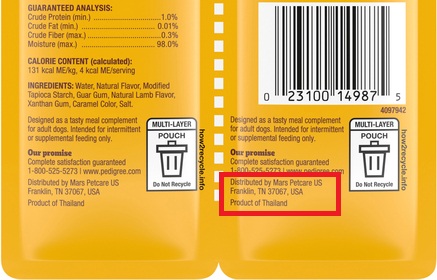
That last one trips up more new brands than anything else on this list. If you're outsourcing production, you're still the party a state is likely to hold accountable for registration, even without a factory to your name.
Why States Don't Treat These Roles The Same
This is where the "everyone tells you something different" feeling comes from - state statutes genuinely license different combinations of roles.
Take Montana. Its commercial feed law requires a license from anyone who manufactures feed in the state, anyone who distributes it into the state, and anyone whose name appears on the label as guarantor, three separate triggers, any one of which can apply to you.
Nevada takes a similar approach. Its statute covers manufacturers, distributors, and guarantors under one licensing requirement, with a single annual fee structure that applies regardless of which of those roles you're filling.
Pennsylvania draws the line differently. The state requires a license for each feed manufacturing facility located in Pennsylvania and, separately, for each guarantor distributing product into the state, but it doesn't require product registration at all, just labels on file.
That's three states with three different combinations of who's on the hook, and when you multiply that by fifty, you can see why brands selling nationally end up needing a real system for tracking who registers where, rather than assuming one state's rule applies everywhere else.
When The Retailer's Name Is On The Bag
Private label is one of the busiest corners of the pet aisle right now. According to Cascadia Capital data reported by PetfoodIndustry, private label pet care dollar sales grew 1.7% in 2024 and unit sales grew 3.5%, while national pet food brands saw 1.0% dollar growth and a 0.6% dip in units. Shoppers are warming up to store brands too. A September 2025 Packaged Facts survey found that 47% of pet owners believe private label pet food matches national brands on quality, compared with 37% in October 2023.
That growth adds a wrinkle to the "who registers?" question. On a store-brand product, the retailer's name usually appears on the label as the distributor, which makes the retailer the guarantor in most states. Following the logic above, you'd expect the retailer to handle its own licensing and registration.
Many retailers do handle it themselves, but some write registration into their vendor agreements and ask their private label manufacturers or suppliers to register products on the retailer's behalf. That means a manufacturer can have a licensing obligation tied to its business relationship with the retailer, even when its name isn't the one on the label. This isn't universal. Expectations vary from retailer to retailer, and sometimes from one program to another within the same retailer.
If you make or supply private label products, confirm these details before the first shipment goes out:
- Who the vendor agreement names as responsible for state licenses and product registrations
- Whose name the registrations should be filed under, and who covers the fees
- Who's on the hook for annual renewals and tonnage reporting once products are on shelves
- What documentation the retailer wants as proof that everything's in order
Retailers are asking more of their suppliers across the board (we covered that in what retailers want from pet food brands), and registration is part of that picture. If you're not sure what a retailer expects from you, we can help you sort out their requirements and handle the registrations if they fall to you.
A Simple Way To Sort Yourself Out
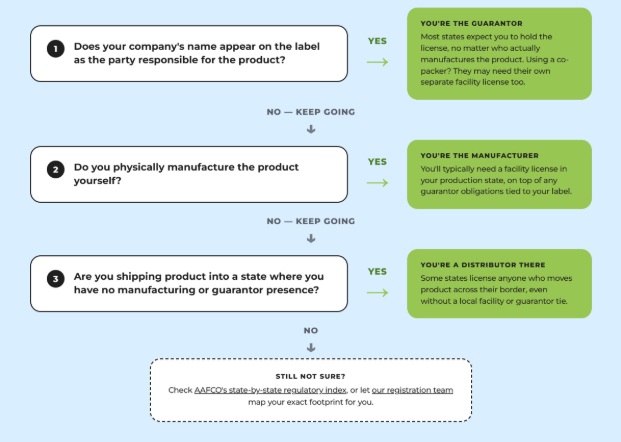
If you're trying to figure out where you fall, start by answering these questions honestly:
- Does your name appear on the label as the guarantor? If so, plan on being the party most states expect to license, regardless of who ran the production line.
- Do you manufacture in-house, or use a co-packer? In-house manufacturers usually carry both the manufacturing and guarantor obligations. Brands using a co-packer usually carry just the guarantor side, but the co-packer may have its own separate facility obligations in the state where it's located.
- Are you shipping into a state without a physical presence there? That's typically where distributor rules kick in, even if you never set foot in the state yourself.
- Are you producing private label product for a retailer? Check your vendor agreement. Some retailers ask their suppliers to register products for them, so you could have obligations even if your name never appears on the bag.
None of this is guesswork you should have to do alone. AAFCO maintains a state-by-state regulatory overview as a starting point, and we've written before about how AAFCO's labeling rules trip up brands who assume the rules are consistent everywhere. If you're not sure whether your label reflects the right party in the first place, our 2-minute labeling quiz is a fast way to check before it becomes a retailer problem.
Don't Let The Layers Trip You Up
The honest answer to "who needs to register?" is: it depends on your role, and it depends on the state. I know that's not a satisfying answer when you're trying to launch, but it's the accurate one, and it's why so many brands end up managing a spreadsheet of fifty different rule sets instead of a launch checklist.
This is the piece of compliance work we handle every day. Our registration services track manufacturer, guarantor, distributor, and retailer-driven requirements state by state, so you're not stuck reading fifty statutes (or a stack of vendor agreements) to figure out which one applies to you. And once you know where you're registered, our tonnage reporting support keeps you on top of the recurring deadlines each of those licenses brings with it.
Getting your labels and your licensing to agree on who's responsible for what is one of those things that's much easier to fix before launch than after a retailer asks a question you can't answer.
More Industry Updates
Join Our Newsletter
Good stuff only — we promise!

